
Texas DPS Permit Practice Test 35
- Questions30
- Correct to pass21
- Passing score70%
- Minimum age15 years
-
1. You are about to pass a large truck on a two-lane highway. Which practice is correct?
Show answer
Answer A: Finish the pass without delay and expect wind turbulence beside the truck
Lingering beside a truck keeps you in its blind spot and exposes you to air turbulence. Pass on the left, keep moving, and move back only when you can see the whole truck in your mirror.
-
2. What can a Texas county commissioners court establish for a county road or bridge, along with the authority to weigh vehicles for compliance?
Show answer
Answer D: Weight limits for that road or bridge
Section 251.153 lets a commissioners court establish load limits for a county road or bridge and authorize officers to weigh vehicles for compliance.
-
3. You have turned onto a ramp at night and your headlights pick out large white arrows painted on the pavement pointing straight back at you. What do they mean?
Show answer
Answer C: You are traveling against the flow and must turn back
Wrong-way arrows are laid so that a driver going the correct way never sees them head on, so an arrow pointing at you means you are on the ramp backwards.
-
4. The route marker used for an Interstate highway is a shield with
Show answer
Answer A: white numerals on a blue field under a red band carrying the word INTERSTATE
The Interstate route marker is a cutout shield with a white border, the word INTERSTATE in white on red across the top and the route number in white on blue.
-
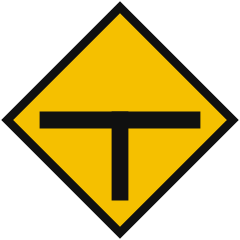
5. What must a driver be prepared to do at the point this sign refers to?
Show answer
Answer D: Turn left or right, because the road being traveled ends there
The road ends at another roadway, so the driver must slow, give way to traffic on the through road and turn in one direction or the other.
-
6. A highway lane is marked with a large white diamond and signed as a high-occupancy vehicle lane. Who may use it?
Show answer
Answer B: Only vehicles carrying at least the number of occupants shown on the sign, during the posted hours
The diamond marking identifies a preferential lane whose occupancy requirement and hours of operation are stated on the accompanying signs.
-
7. Which of these is announced with the same family of signs as the facility shown here?

Show answer
Answer A: A rest area for travelers
A rest area belongs to the same motorist service series, which points travelers toward facilities such as fuel, food, lodging and medical care.
-
8. You are waiting to turn left at a solid green light with no green arrow. Oncoming traffic is approaching. What should you do?
Show answer
Answer A: Yield to the oncoming traffic and turn only when there is a safe gap
A solid green light permits the left turn but does not protect it, so you must yield to oncoming vehicles and to pedestrians before turning.
-
9. A school crossing guard has returned to the curb but two children are still walking across the road. When may you go?
Show answer
Answer C: Only after the children have reached the far sidewalk
The guard leaving the road does not end your duty; you stay stopped until every child is clear of the roadway.
-
10. In which situation should you increase your usual following distance?
Show answer
Answer B: On wet roads, at night, in fog, when towing a trailer, or when following a motorcycle
Reduced traction, reduced visibility, a heavier load and a vehicle that can stop faster than yours all require extra space to keep the same margin of safety.
-
11. You are approaching a horse and rider on a country road. What about your horn?
Show answer
Answer C: Do not sound it at all, because the noise can frighten the animal
A startled horse is dangerous to its rider and to you, so pass wide and slow and leave the horn alone.
-
12. Texas requires a driver leaving a vehicle unattended to stop the engine and remove the key. When do those two requirements not apply?
Show answer
Answer C: When a remote starter was used and the key is needed to drive
The stop-engine, lock-ignition and remove-key rules do not apply when the engine is started remotely without the key and the key must be present before the vehicle can be driven. The parking brake and wheel rules still apply.
-
13. You notice a bulge on the sidewall of one of your tires. What should you do?
Show answer
Answer D: Have the tire replaced before driving far, because it could blow out
A sidewall bulge means the internal cords have broken and only the rubber is holding the air. The tire can fail suddenly at any speed.
-
14. A steady red arrow is displayed for your left-turn lane at a two-way intersection. What must you do?
Show answer
Answer C: Stop and remain stopped until an indication permits the turn
A steady red arrow prohibits the movement it points to, so the driver stops and waits for a green arrow, a flashing yellow arrow or another indication that permits the turn.
-
15. You are in a minor collision on a busy road. No one is hurt and both vehicles can be driven. What is the recommended thing to do?
Show answer
Answer C: Move the vehicles out of the travel lanes to a safe spot before exchanging information
Vehicles left in traffic after a minor crash invite a second, often worse, collision. Clearing the lane protects everyone, and you still exchange details and report as required.
-
16. You hold steady pressure on the brake pedal for the whole of a long descent. What is likely to happen?
Show answer
Answer B: The brakes overheat and fade, so they slow you less and less
Continuous braking heats the brakes until they fade and lose effectiveness; use a lower gear and short, firm applications instead.
-
17. Besides motorist services and tourist information, a blue sign background is also used for
Show answer
Answer B: evacuation route signing
Blue is assigned to road user services, tourist information and evacuation routes, so hurricane and other evacuation routes are signed in blue.
-
18. In normal operation, which indication always comes between a green and a red on the same signal face?
Show answer
Answer C: A steady yellow
The yellow change interval must follow every green or green arrow, so a signal can never jump straight from green to red.
-
19. What is the main function of the guide sign series?
Show answer
Answer D: To identify routes and lead road users to their destinations
Guide signs identify routes, name destinations and give distances, so drivers can navigate without stopping to consult a map.
-
20. What is a good habit when you open the door on the traffic side of a parked car?
Show answer
Answer C: Use the hand farther from the door, which turns you to look back
Reaching across with the far hand rotates your body and brings the mirror and the road behind into view before the door moves.
-
21. Where is a three-point turn most clearly a bad idea?
Show answer
Answer A: On a busy street near a curve, where approaching drivers cannot see you
The maneuver leaves you blocking the road for several seconds, so it needs light traffic and a long clear view; a blind curve gives neither.
-
22. A pedestrian starts to cross against a Do Not Walk signal, right in front of you. What should you do?
Show answer
Answer D: Slow or stop and let the person reach safety
Even when a pedestrian is crossing unlawfully, a driver must take reasonable care to avoid hitting that person.
-
23. You have signaled and pulled up level with the car in front of an empty curb space. What comes next?
Show answer
Answer A: Reverse slowly while turning the wheel toward the curb
From alongside the forward car you back in on a turn toward the curb, then straighten and swing the front in as the rear reaches the space.
-
24. Where is the safest place for children under 13 to ride?
Show answer
Answer C: In the back seat
The back seat keeps children away from the force of a deploying front air bag and is farther from the most common impact area, which is why it is recommended through at least age 12.
-
25. You receive a phone call that you feel you must answer while driving. What is the safest way to take it?
Show answer
Answer D: Pull off the road, stop in a safe place and then answer
No call is worth a crash. Stopping in a safe location removes the distraction completely, while every other option divides your attention.
-
26. The traffic signal is green, but the crossing lights on the tracks inside the intersection begin to flash. What must you do?
Show answer
Answer C: Stop clear of the tracks and wait, even though the signal is green
Active crossing warning devices outrank the green indication, so you stop short of the rails and wait until the warning stops.
-
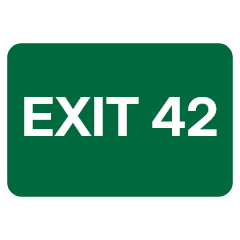
27. A driver in the left lane of a freeway realizes only when level with this sign that the ramp beside it is the one they need. What is the correct action?
Show answer
Answer A: Carry on to the next interchange and turn back from there
There is no safe way back to a ramp once it has been reached from the wrong lane, so the driver keeps going to the next interchange, where the ramps are built for that movement.
-
28. You pull onto a soft grass verge to park. What is the main risk?
Show answer
Answer A: The wheels can sink and the car can slide toward the ditch
Soft ground gives way under the weight of a vehicle, and a car that settles or slides sideways can end up stuck or in the ditch.
-
29. A sign at the intersection prohibits U-turns, but the opening looks wide and clear. What may you do?
Show answer
Answer B: Obey the sign and turn around somewhere else
A prohibition applies whatever the traffic looks like at that moment, usually because of sight distance or conflicts you cannot see from the lane.
-
30. A pedestrian using a white cane or walking with a guide dog starts to cross the street ahead of you. What must you do?
Show answer
Answer A: Yield and stay stopped until the person has finished crossing
A white cane or guide dog identifies a pedestrian who may not be able to see your vehicle, so you must yield and wait rather than maneuver around the person. The horn can confuse the pedestrian or the dog.