
Texas DPS Motorcycle Practice Test 10
- Questions20
- Correct to pass16
- Passing score80%
- Minimum age15 years
-
1. Why is an inexperienced rider a poor choice to lead a group?
Show answer
Answer C: The leader picks the pace, the gaps and the hazards for everyone behind
Every decision the leader makes is imposed on the riders behind, so leading demands more traffic judgment than any other position in the group.
-
2. A yellow sign reading DEAD END is posted at the entrance to a street. What does it mean?
Show answer
Answer D: The street ends and there is no way through
A dead end street stops at its far end, so a driver who enters must come back out the same way.
-
3. You feel fine twenty minutes after your last drink. Why is that a poor guide to driving?
Show answer
Answer B: Your blood alcohol level can still be rising
Alcohol keeps being absorbed for some time after the last drink, so a driver who feels able at the door can be more impaired a few miles down the road.
-
4. Four vehicles reach a four-way stop from all four directions at the same instant. How is the deadlock resolved?
Show answer
Answer C: Each driver yields to the vehicle on the right and they go one by one
Yielding to the right applies to every driver, so the group untangles itself as drivers take turns rather than moving together.
-
5. You turn from asphalt onto a loose gravel road. What should you do about your speed?
Show answer
Answer D: Lower it, since grip is reduced and stopping takes longer
Loose gravel gives far less grip than pavement, so speed must come down for both steering and stopping.
-
6. What is the main reason a rider should keep a generous following distance on a rough, broken road?
Show answer
Answer B: So the rider can see and plan for holes and broken pavement in time to react
The vehicle ahead hides the pavement, so extra space gives you time to spot a hole or a broken edge and to choose a path around it.
-
7. A bicyclist is riding in the middle of a narrow travel lane ahead of you. What is the correct response?
Show answer
Answer D: Slow down and wait until you can pass with wide clearance, changing lanes if needed
A bicyclist has the same right to use the lane as a driver, and a narrow lane may not leave safe passing room, so wait for a gap that lets you move over and pass with a wide margin.
-
8. What is true about the oily strip down the center of a traffic lane?
Show answer
Answer D: It usually gives enough traction, but heavy buildups where vehicles idle should be avoided
Passing tires keep the central strip largely clear, but the thick deposits that collect at busy intersections and toll booths really are slick.
-
9. Which clothing offers the best protection for a rider?
Show answer
Answer D: Leather or sturdy synthetic gear covering the arms and legs completely
Leather and purpose built synthetics resist abrasion far better than ordinary clothing, and full coverage also guards against sun, wind chill and flying debris.
-
10. A sign at the curb reads Tow-Away Zone. What does it mean for you?
Show answer
Answer C: That a vehicle left there can be removed at the owner's expense
In a tow-away zone the vehicle can be removed immediately and the owner pays the towing and storage charges to get it back.
-
11. An arrow panel at a work zone displays a flashing arrow pointing to the left. What does it require?
Show answer
Answer C: Move out of the closed lane into the lane on the left
A flashing or sequential arrow on an arrow panel directs traffic out of a closed lane and into the lane the arrow points to.
-
12. Apart from giving you room to stop, what else does a longer following gap do for you?
Show answer
Answer D: It widens your view of the road and the traffic ahead
Sitting further back lets you see past and around the vehicle in front, so hazards reach your eyes seconds earlier.
-
13. Which of these places should never be used to turn your vehicle around?
Show answer
Answer C: The driveway of a fire station or the roadway in front of it
Turning around in or in front of a fire station driveway can block emergency vehicles leaving, and most states prohibit it.
-
14. Why do experienced riders cover the clutch lever and the brake lever in heavy traffic?
Show answer
Answer B: It shortens the time needed to react if they suddenly have to stop
With fingers already resting on the levers the rider skips the time it takes to reach for them, which shortens overall stopping distance.
-
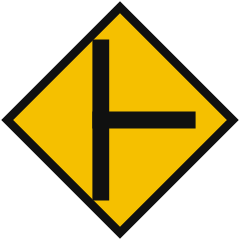
15. What condition does this sign warn a driver about?
Show answer
Answer B: Another road joins the road being traveled, from one side
It announces a side road entering the main roadway, so the driver should expect vehicles waiting to pull out and other vehicles slowing to turn in.
-
16. What should motorcycle footwear provide?
Show answer
Answer B: Sturdy support above the ankle with hard, slip resistant soles
Boots that cover the ankle support and protect it, while hard slip resistant soles keep the rider steady at stops, and laces should be tucked in so they cannot catch.
-
17. What should a passenger be told about moving around on the motorcycle?
Show answer
Answer A: To stay directly behind the operator and avoid sudden or unnecessary movement
Unexpected movement by a passenger upsets the balance of the machine, most of all at low speed and while the motorcycle is leaned over in a turn.
-
18. How should a load be distributed between the two saddlebags?
Show answer
Answer B: Evenly, so the weight is balanced from side to side
An uneven load pulls the motorcycle toward the heavy side and makes it behave differently in left turns than in right turns.
-
19. Warning signs such as stop ahead, yield ahead and signal ahead are installed mainly where
Show answer
Answer B: the traffic control device cannot be seen from far enough away
These advance warning signs are used when a crest, curve or obstruction keeps the stop sign, yield sign or signal from coming into view in time for a driver to react.
-
20. On a typical motorcycle, which of these controls does the rider operate with the right hand?
Show answer
Answer C: The front brake lever
The front brake lever sits on the right handlebar and is squeezed with the right hand, while the clutch lever is on the left handlebar.