
Texas DPS Motorcycle Practice Test 44
- Questions20
- Correct to pass16
- Passing score80%
- Minimum age15 years
-
1. What is true about driving away from a crash you were involved in?
Show answer
Answer B: It is a serious offense, even if the other driver has driven away too
Leaving the scene is a criminal offense in every state, and the behavior of the other driver does not excuse it.
-
2. You come up behind a group of cyclists riding two abreast on a narrow rural road. What should you do?
Show answer
Answer A: Wait for a clear stretch and pass them as one group
Passing a group as a single unit when the way ahead is clear is safer than several rushed passes, and cutting through the group leaves nobody any escape room.
-
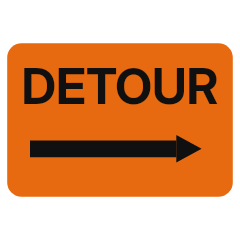
3. Which of these is true of the roadway a driver is being sent onto here?
Show answer
Answer D: Its own signs, signals and speed limits govern for the whole way around
The alternate route is an ordinary public road, so every control posted on it governs as usual; being sent that way grants no extra priority and no relief from the limits in force there.
-
4. What matters most about the armor built into a riding jacket?
Show answer
Answer B: That it sits over the joints and stays there during a fall
Armor only works where it is, so the jacket must fit closely enough that the pads stay over the shoulders, elbows and spine when the rider hits the ground.
-
5. How long should a rider stay in the oncoming lane while passing?
Show answer
Answer D: Only as long as completing the pass safely requires
Every extra second in the oncoming lane is exposure with no benefit, so the rider passes decisively and returns as soon as the road behind is clear.
-
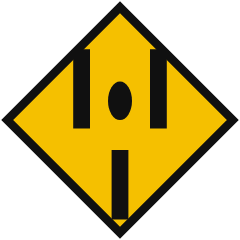
6. What must a driver be ready for beyond this sign?
Show answer
Answer C: Vehicles approaching from the opposite direction in the next lane over
The separation between the two directions runs out, so from that point oncoming vehicles share the same pavement and the driver has to keep right.
-
7. How much of a traffic lane is a motorcycle entitled to use?
Show answer
Answer D: The full width of the lane
A motorcycle is entitled to the full lane, and riders move within it to stay visible and to avoid surface hazards, so drivers should never try to share a lane with one.
-
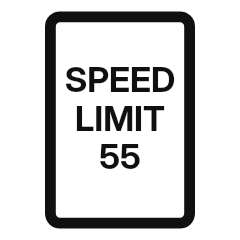
8. On a clear day with light traffic, a driver stays far below the maximum this sign sets. What can that cause?
Show answer
Answer B: Obstruction of the normal flow of traffic, which is prohibited in itself
Driving so slowly that other traffic is impeded is an offense in its own right when nothing about safety, weather or the road calls for it.
-
9. How much alcohol may a Texas driver under 21 have in the body while driving?
Show answer
Answer C: None, because any detectable amount is an offense
The Texas zero tolerance rule makes it an offense for anyone under 21 to drive with any detectable amount of alcohol in the system.
-
10. What is lane splitting?
Show answer
Answer B: A motorcycle riding between two lanes of traffic moving the same way
Lane splitting means riding along the line between two lanes of traffic going in the same direction rather than staying within a lane.
-
11. Who is best suited to ride as the sweep at the back of a group?
Show answer
Answer B: An experienced rider who can handle a problem at the back
The sweep has to notice a rider dropping back or stopping and deal with it away from the rest of the group, which takes judgment and experience.
-
12. Are ordinary eyeglasses or sunglasses adequate eye protection for riding?
Show answer
Answer B: No, since they can shatter and let wind reach the eyes from the side
Everyday lenses are not made to resist impact and leave the eyes open to wind and debris, so a face shield or goggles are needed instead.
-
13. Your road ends at a T-intersection with no signs or signals. Who has the right-of-way?
Show answer
Answer A: Traffic on the through road, and you must yield before entering
A driver on a road that ends at a T-intersection must yield to traffic on the through road that continues past the junction.
-
14. Some crosswalks are marked with two transverse lines and others with a row of wide bars laid along the direction of travel. Why is the second pattern used?
Show answer
Answer B: It is far easier for an approaching driver to see
Longitudinal bar patterns are used where extra visibility is wanted, such as an uncontrolled crossing or one near a school, because they show up much better from a car.
-
15. What is wrong with riding in sneakers or sandals?
Show answer
Answer D: They come off, expose the foot and give no protection in a fall
Light footwear tears away or comes off in a crash and offers no abrasion or crush protection for the foot and ankle.
-
16. Why do many crashes happen on routes the driver knows very well?
Show answer
Answer D: Familiar roads let attention slip into routine
When a route is automatic the mind wanders and hazards get missed, which is why a well known road deserves the same attention as a strange one.
-
17. An emergency vehicle is stopped on the shoulder ahead with its lights flashing. What does the move over principle require?
Show answer
Answer D: Change lanes away from it, or slow down if you cannot
Move over laws ask you to give responders an empty lane, and where traffic or a two-lane road makes that impossible, you slow down instead.
-
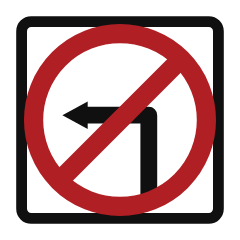
18. A driver in the leftmost lane reaches this sign at an intersection. What must the driver do?
Show answer
Answer B: Go straight on or turn right, and reach the destination another way
The restriction holds whatever the traffic or the signal is doing, so the driver has to pass the intersection and plan a different route.
-
19. How should space management change with a passenger aboard?
Show answer
Answer B: Allow a greater following distance and wait for larger gaps in traffic
A loaded motorcycle accelerates and stops more slowly, so it needs more room ahead and bigger gaps to merge, to pass or to cross traffic.
-
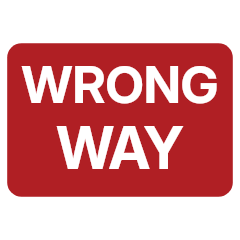
20. At a freeway exit ramp, this sign normally backs up which other regulatory sign posted nearer to the ramp terminal?
Show answer
Answer D: The sign that forbids entering that roadway at all
The two work as a pair at ramp terminals: one keeps drivers from turning in, and this one sits farther along to catch a driver who has already entered.