
Texas DPS Motorcycle Practice Test 68
- Questions20
- Correct to pass16
- Passing score80%
- Minimum age15 years
-
1. A pedestrian steps off the curb in the middle of a block where there is no crosswalk at all. What is the legal position?
Show answer
Answer A: They must yield to you, but you must still avoid a crash
A pedestrian crossing away from a crosswalk yields to vehicles, yet every driver still has a duty to use care and avoid hitting a person.
-
2. What is the best way to handle fatigue on a long ride?
Show answer
Answer C: Take rest breaks regularly and dress to keep wind and cold out
Wind, vibration and cold tire a rider faster than a driver, and the safe answer is planned breaks and protective clothing rather than pressing on.
-
3. What should a pre-ride check of a belt final drive look for?
Show answer
Answer C: Correct tension, plus cracks, frayed edges and missing teeth
A belt is inspected for tension and for damage such as cracks, missing teeth and worn edges, and unlike a chain it is never lubricated.
-
4. Your route crosses a long steel grid bridge deck. What should you do about braking and speed while you are on the grating?
Show answer
Answer B: Keep a steady speed and do any braking before the grating, not on it
A steel deck makes the motorcycle weave and offers less grip, so set your speed before you reach it, ride straight across, and brake on solid pavement.
-
5. How does alcohol typically affect a driver's vision?
Show answer
Answer D: It blurs vision, weakens night vision and narrows attention to the sides
Alcohol slows the eye muscles and the brain's processing of what is seen, degrading focus, night vision, depth perception and awareness of movement at the edges of the field of view.
-
6. Heavy rain has left water standing on the highway. What is the main risk to a rider?
Show answer
Answer D: The tires can ride up on the water and lose contact with the road surface
At higher speeds a tire can no longer push standing water aside and starts to hydroplane, so the rider slows and eases off rather than braking or turning hard.
-
7. The rider ahead of you has just passed a slow vehicle on a two lane road. What does that tell you about your own pass?
Show answer
Answer C: Nothing, because you must judge the oncoming traffic yourself
Every pass uses up part of the gap, so the space that was ample for the rider ahead may be far too short by the time it is your turn.
-
8. You enter a work zone where the top layer of pavement has been milled off, leaving a grooved surface. How should you ride?
Show answer
Answer B: Hold a relaxed grip and steady speed, and expect the tires to wander
Milled or grooved pavement makes the tires follow the ridges and the motorcycle feel unsettled, so relax on the bars, keep a constant speed and ride straight through.
-
9. Unless on official business, how closely may a Texas driver follow a fire apparatus responding to a fire alarm?
Show answer
Answer A: No closer than 500 feet
Texas law bars following a fire apparatus answering an alarm closer than 500 feet, and the same distance applies to an ambulance flashing red lights.
-
10. Which use of a handheld phone is an affirmative defense under the Texas texting while driving law?
Show answer
Answer B: Using it to navigate with a GPS application
Defenses include navigation, hands-free use, reporting illegal activity or summoning help, reading a message believed to concern an emergency, dispatch devices affixed to the vehicle and activating music.
-
11. Windblown sand has collected across the pavement at a rural intersection where you must stop. How should you handle the stop?
Show answer
Answer A: Do your braking on clean pavement before the sand, then roll across upright
Sand acts like ball bearings under the tires, so finish your braking on the clean surface ahead of it and cross the loose patch upright with no sudden inputs.
-
12. If you must abandon a vehicle stuck on the tracks with a train coming, why do you move toward the train and away at an angle?
Show answer
Answer D: Because debris from the impact is thrown forward, away from the train
A train pushes wreckage down the track ahead of it, so walking toward the train and off to the side keeps you out of the debris path.
-
13. About how far does a vehicle travel in one second at 60 mph?
Show answer
Answer A: About 88 feet
At 60 mph you cover about 88 feet every second, which is why a glance of only two or three seconds means driving the length of several vehicles blind.
-
14. Where should the weight of a load sit in relation to the rear axle?
Show answer
Answer A: Over the rear axle or in front of it
Weight placed behind the rear axle acts as a lever against the steering and can make the motorcycle wobble and handle and brake poorly.
-
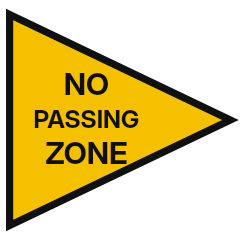
15. A driver is thinking about overtaking a slower vehicle and sees this sign a short distance ahead. What does it mean for that pass?
Show answer
Answer B: The pass must be finished before the restricted section begins
The sign marks the start of a section where passing is prohibited, so a driver may not be on the left side of the road beyond it; any pass has to be completed before that point or not started at all.
-
16. How should a group plan its rest stops on a long day?
Show answer
Answer A: Around the rider who tires first, with breaks before anyone is worn out
Fatigue destroys judgment long before a rider admits to it, so the break schedule follows the least rested rider rather than the strongest one.
-
17. You are passing a large truck on an open highway in a strong crosswind. What should you expect?
Show answer
Answer A: A push toward the truck, then a push the other way as you clear it
The truck shelters you as you go by and then releases you into the full gust, so the load on the steering changes twice during the pass.
-
18. What limits how much weight a motorcycle can carry?
Show answer
Answer A: The load limit given by the manufacturer for that machine
The manufacturer's figure covers the rider, the passenger and everything carried, and going over it overloads the tires, the brakes and the suspension.
-
19. You come up behind a bicyclist who is descending a steep hill in the middle of the traffic lane. What should you take into account?
Show answer
Answer D: The rider may be moving at close to the speed of the traffic
A bicycle can reach the speed of traffic on a descent, so there is little to gain from a pass and the rider needs the whole lane to steer around surface hazards.
-
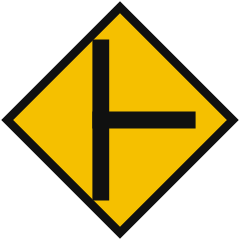
20. Approaching the point this sign refers to, which hazard is most likely?
Show answer
Answer A: A vehicle pulling out from the entering road into the driver's path
The main risk is a driver on the entering road who misjudges the gap and pulls out, so covering the brake and being ready to slow is the sensible response.