
Texas DPS Permit Practice Test 10
Test 10 of 10. Pick an answer for each question to see if it is right and why; your score appears at the end. You need 21 correct answers to pass, the same ratio as the real Texas test.
- Questions30
- Correct to pass21
- Passing score70%
- Minimum age15 years
-
1. Which body may raise the prima facie speed limit on a Texas state highway after an engineering and traffic investigation?
Show answer
Answer B: The Texas Transportation Commission
Transportation Code Section 545.353 gives the Texas Transportation Commission authority to raise the prima facie speed limit on the state highway system following an engineering and traffic investigation.
-
2. How should a head restraint be adjusted?
Show answer
Answer D: So the top is at least as high as the back of your head and close behind it
A restraint set at head height and close behind limits how far the head snaps backward in a rear impact, which is what reduces neck injury.
-
3. You are driving in the left lane at the posted speed limit and a line of vehicles has built up behind you. What should you do?
Show answer
Answer D: Move into a lane on your right when it is safe and let the traffic behind go by
Most states require traffic moving slower than the flow to keep right and reserve the left lane for passing, so a driver holding up a line of vehicles should move right when it is safe rather than block the lane.
-
4. Your right wheels have dropped onto a soft shoulder. Why should you not steer straight back onto the pavement?
Show answer
Answer A: The tires can catch the pavement edge and throw you across the road
A tire pressed against the edge of the pavement climbs it suddenly, and at speed that jolt can send the vehicle across the center line.
-
5. What fine range applies to a first Texas Move Over or Slow Down violation?
Show answer
Answer C: Not less than 500 and not more than 1,250 dollars
A first offense carries a fine of at least 500 and at most 1,250 dollars, and a second offense within five years raises the range to 1,000 to 2,000 dollars.
-
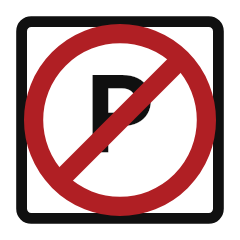
6. Why is this restriction so common beside fire hydrants, crosswalks and intersection corners?
Show answer
Answer C: To keep sight lines open and leave access for emergency crews
A vehicle left in those places hides pedestrians from approaching drivers, blocks the path of turning vehicles and can keep firefighters from reaching a hydrant.
-
7. The signal ahead turns yellow while you are approaching it. What does the yellow light mean?
Show answer
Answer C: The red is coming; stop if you can do so safely
A steady yellow warns that the red is next. Stop if you can do so safely; enter the intersection only when stopping would be dangerous.
-
8. What is the maximum penalty for leaving the scene of a collision that causes an injury (not death) in Texas?
Show answer
Answer A: Up to 5 years in prison, or up to 1 year in jail plus a fine of up to $5,000
Section 550.021(c) allows imprisonment of up to 5 years, or up to a year in jail combined with a fine of as much as $5,000, for leaving the scene of an injury collision.
-
9. A tractor-trailer is backing slowly across the roadway to enter a loading dock. What should you do?
Show answer
Answer C: Stop and wait until the truck has finished the maneuver
A backing truck driver has a very limited view and the trailer can swing unexpectedly. Trying to squeeze past in either direction risks being crushed.
-
10. How soon after purchasing a vehicle must a Texas owner apply for registration?
Show answer
Answer B: Not more than 30 days after the purchase
Section 502.040(a) sets a deadline for applying for registration after purchasing a vehicle, the same deadline used for a new resident.
-
11. An emergency vehicle is stopped on the shoulder ahead with its lights flashing. What does the move over principle require?
Show answer
Answer D: Change lanes away from it, or slow down if you cannot
Move over laws ask you to give responders an empty lane, and where traffic or a two-lane road makes that impossible, you slow down instead.
-
12. A driver extends the left arm out the window and bends it upward at the elbow. What does this signal mean?
Show answer
Answer B: A right turn
The left arm bent upward at the elbow is the standard hand signal for a right turn.
-
13. Under the Texas Move Over or Slow Down law, what must a driver do who cannot change lanes away from a stopped emergency or service vehicle?
Show answer
Answer D: Slow to 20 mph below the posted limit, or to 5 mph where the posted limit is under 25 mph
When the lane cannot be vacated, Texas requires a reduction to 20 mph below the posted limit, or to 5 mph if the posted limit is less than 25 mph.
-
14. What is a marked loading zone for?
Show answer
Answer A: Loading and unloading only, not for general parking
A loading zone is reserved for actively loading or unloading goods or passengers; leaving a vehicle there for other reasons is a parking violation.
-
15. Alcohol is classified as which kind of drug?
Show answer
Answer B: A depressant that slows the central nervous system
As a depressant, alcohol slows the brain and nervous system, which lengthens reaction time and dulls the coordination that driving depends on.
-
16. In heavy stop-and-go traffic, why does using both lanes right up to a merge point help?
Show answer
Answer D: It stores the queue in two lanes, so the backup is shorter
Filling both lanes halves the length of the queue and keeps it away from the traffic upstream, which is why alternating at the merge point works better when traffic is slow.
-
17. How far to the rear must a Texas vehicle's required mirror allow the operator to see?
Show answer
Answer C: At least 200 feet
Section 547.602 requires a mirror positioned to give the operator a view of the highway for at least 200 feet to the rear.
-
18. Which surfaces usually offer less grip than the pavement around them when wet?
Show answer
Answer B: Painted markings, metal plates and bridge decks
Paint, steel and bridge decks all shed grip when wet or cold, so brake before you reach them rather than on top of them.
-
19. When a Texas driver must file a certificate of insurance following a collision, what minimum policy period must that certificate cover, with the premium paid in full?
Show answer
Answer A: At least six months
Section 601.153(b) requires a post-collision certificate of insurance to cover a set minimum policy period, with the premium paid in full for that period.
-
20. When is it acceptable to reach into the back seat for something while driving?
Show answer
Answer A: Never; stop somewhere safe instead
Twisting round takes your eyes off the road and your control of the wheel with it, so anything in the back seat waits until the car is stopped.
-
21. What does a tire with worn tread do on a wet road?
Show answer
Answer B: It loses grip and it hydroplanes at a lower speed than a good tire
Tread grooves carry water away from the contact patch, and a worn tire cannot do that, so it floats on the water sooner.
-
22. As a driver keeps drinking, in what order are driving abilities usually lost?
Show answer
Answer C: Judgment, then vision, reaction time and coordination
Alcohol reaches the parts of the brain that handle judgment first, and only later does it visibly affect sight, reactions and muscle control.
-
23. A small signal face beside a bikeway shows red, yellow and green lenses that each carry a bicycle symbol. Whom does it control?
Show answer
Answer C: Bicyclists using that crossing or bikeway
A bicycle signal face governs bicycle movements only, and people on foot at the same corner still follow the pedestrian signal.
-
24. A center lane is marked with a broken yellow line on each side and is controlled by overhead lane signals. How is that lane used?
Show answer
Answer A: It carries traffic one way or the other according to the signals
A reversible lane is marked with broken yellow lines on both sides and its direction of travel is set by the lane control signals above it.
-
25. The accelerator sticks open while you are driving. What is the first thing to do?
Show answer
Answer A: Shift into neutral and brake while steering off the road
Neutral disconnects the engine from the wheels so the vehicle can be braked normally, while shutting off the ignition may lock the steering and remove power assistance.
-
26. You are passing a line of slow traffic in the lane beside you and you notice a gap in that line ahead. What should you expect?
Show answer
Answer A: A vehicle may pull out of that gap into your lane
A gap in a slow line is an invitation to any driver waiting to turn out of a side street or to change lanes, and they are looking at the gap rather than at you.
-
27. A sign on a long descent points to a RUNAWAY TRUCK RAMP a mile ahead. What is that ramp for?
Show answer
Answer C: Stopping a vehicle whose brakes have failed
An escape ramp climbs into deep gravel or sand to bring a vehicle with failed brakes to a halt, so no one should stop or park in it.
-
28. A driver sees this sign on a quiet road with no other traffic in either direction. What is the correct response?

Show answer
Answer C: Slow down, look and listen for a train, and be ready to stop
The sign gives advance notice of a highway-rail grade crossing, so the driver reduces speed, checks both directions along the tracks and keeps enough room to stop short of the rails.
-
29. The lane you are in is marked with a straight arrow and a right-turn arrow together. What does that mean?
Show answer
Answer D: Drivers in that lane may either go straight or turn right
A lane marked with two arrows serves both movements, so a driver in it may take either one.
-
30. How long is the administrative suspension for a Texas driver's alcohol-related test failure if the driver already has a prior alcohol-related contact on record?
Show answer
Answer D: One year
Under Section 524.022(a), a driver with a prior alcohol-related contact faces a longer administrative suspension than a first-time offender with a clean record.