
Texas DPS Permit Practice Test 5
Test 5 of 10. Pick an answer for each question to see if it is right and why; your score appears at the end. You need 21 correct answers to pass, the same ratio as the real Texas test.
- Questions30
- Correct to pass21
- Passing score70%
- Minimum age15 years
-
1. The vehicle ahead of you has pulled out to pass a truck. May you follow it out and pass as well?
Show answer
Answer B: No, wait until it is done and judge the road for yourself
You cannot see past the vehicle ahead of you, and if it has to abort the pass there is nowhere for either of you to go.
-
2. A child in the back seat unfastens a seat belt while you are on the freeway. What should you do?
Show answer
Answer A: Pull off safely and refasten the belt
Turning or reaching back takes your eyes and hands off a high speed task, so leave the freeway or use the shoulder only if there is no exit, then fix the belt.
-
3. What does Texas equipment law require of a vehicle's muffler?
Show answer
Answer B: That it continually operate to prevent excessive or unusual noise, with cutouts and bypasses banned
Section 547.604 requires a muffler in good working condition that continually operates to prevent excessive or unusual noise, and it bans muffler cutouts or bypasses.
-
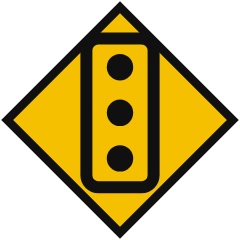
4. A driver passes this sign and the signal beyond it is already showing green. What is the safest response?
Show answer
Answer C: Ease off the accelerator and be ready to stop, because an indication that has been showing for a while is about to change
A signal that has been displaying the same indication for some time is close to changing, so arriving at a controlled speed with the brake covered is safer than accelerating to beat it.
-
5. What speed authority does a Texas county commissioners court have over a segment of county road?
Show answer
Answer D: It may determine and set a maximum reasonable and prudent speed for that segment
Transportation Code Section 251.154 lets a county commissioners court set a maximum reasonable and prudent speed for a county road segment, which may run lower than the standard state highway maximum.
-
6. Every signal head at an intersection is flashing red in all directions. How should you treat the intersection?
Show answer
Answer C: As an all-way stop, stopping and then going in turn
Red flashing in every direction means each approach must stop, so the intersection works exactly like an all-way stop.
-
7. You must slow suddenly on a highway and a vehicle is following close behind you. What helps prevent a rear-end collision?
Show answer
Answer D: Tapping the brake pedal early so your brake lights flash a warning
Early brake light flashes give the driver behind more time to react, and slowing gradually instead of suddenly reduces the chance of being struck.
-
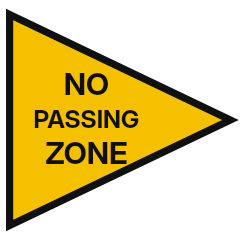
8. Where does the restriction that starts at this sign come to an end?
Show answer
Answer D: Where the centerline markings show that overtaking is allowed again
The sign marks the start of the restricted section, and the centerline markings along the road show how far it runs and where overtaking becomes lawful again.
-
9. What is the main purpose of the TexasSure database used by Texas law enforcement and county officials?
Show answer
Answer C: To quickly identify vehicle owners who lack the required liability insurance
TxDMV describes TexasSure as an automated database designed to quickly identify vehicle owners without the required insurance coverage.
-
10. Where is a U-turn generally the most reasonable choice?
Show answer
Answer B: At an intersection where it is permitted and you can see well both ways
A U-turn needs a legal place and a long clear view in both directions, which is why a permitted intersection with open sight lines is the usual choice.
-
11. You are stopped inside an intersection waiting for a gap to turn left. How should your front wheels be positioned?
Show answer
Answer C: Pointing straight ahead until you actually begin the turn
If your wheels are already turned left and another vehicle strikes you from behind, you would be pushed into oncoming traffic.
-
12. A delivery truck is parked in your lane and you must use the oncoming lane to get around it. Who has the right of way?
Show answer
Answer D: The oncoming traffic, because their lane is clear
The driver whose own lane is obstructed waits, because using the other lane is a favor from oncoming traffic, not a right.
-
13. During the 30 additional hours of behind-the-wheel practice in a Texas parent-taught driver education course, who must be present in the vehicle with the student?
Show answer
Answer B: An adult who meets the qualifications set out in Transportation Code Section 521.222(d)
The additional 30 hours of practice still require a qualifying adult supervisor under Section 521.222(d), the same kind of standard applied to learner license supervision.
-
14. After investigating a qualifying collision, how many days does a Texas peace officer have to file a written collision report?
Show answer
Answer C: 10 days
Section 550.062(b) requires the investigating officer to file the written collision report within 10 days.
-
15. On an overhead guide sign, the small exit number panel sits above the left-hand end rather than the right. What does that placement tell you?
Show answer
Answer A: The exit leaves from the left side of the roadway
The exit number plaque is placed on the side from which the ramp leaves, which gives advance notice of the unusual left-hand exit.
-
16. You are calling 911 to report a crash. Which information matters most?
Show answer
Answer C: The exact location, how many people are hurt and any hazard such as fire
Dispatchers need to know where to send help, how much help to send, and what dangers the crews will meet on arrival.
-
17. You park in your own driveway and the rear of the vehicle sticks out over the sidewalk. What is wrong with that?
Show answer
Answer C: It blocks the sidewalk and forces people into the street
A vehicle overhanging the sidewalk pushes pedestrians, wheelchair users and strollers into the roadway, and blocking a sidewalk is prohibited.
-
18. What did Texas House Bill 2048 from the 86th Legislature accomplish regarding driver penalties?
Show answer
Answer A: It repealed the Driver Responsibility Program and eliminated its program surcharges
House Bill 2048's caption describes repealing the Driver Responsibility Program and eliminating its surcharges, among other changes to traffic fine funds.
-
19. A bike lane on your right is marked with a dashed line for the last stretch before the corner. What does that dashed section allow you to do?
Show answer
Answer D: Merge into the bike lane after checking, and turn right from there
The dashed section is where drivers are meant to merge into the bike lane before turning, which puts cyclists behind the vehicle instead of beside it.
-
20. You are driving on a two-lane road approaching the crest of a hill. Where should you position your vehicle?
Show answer
Answer D: Toward the right side of your lane, in case an oncoming vehicle is over the center line
You cannot see what is beyond a crest, and oncoming drivers sometimes drift across the center. Keeping right and slowing gives you a margin.
-
21. Which of these makes you unpredictable to other drivers?
Show answer
Answer B: Changing lanes suddenly without signaling, to save a moment
An unsignalled, sudden lane change gives nobody time to react and is a common cause of sideswipe collisions.
-
22. A white arrow painted in your lane points only to the right, and a sign above the lane shows the same movement. What must you do?
Show answer
Answer C: Turn right from that lane
Pavement arrows used with lane-use signs are regulatory, so a driver occupying that lane must make the movement shown.
-
23. Why does a dirty windshield matter much more at night than during the day?
Show answer
Answer C: Dust and streaks scatter oncoming light and increase glare
Film and streaks on the glass spread every oncoming headlight into a star of glare, so clean the inside as well as the outside before a night trip.
-
24. When must a Texas driver stop for a school bus under the school bus passing law?
Show answer
Answer D: When approaching the bus while it is stopped and displaying its visual signals
Section 545.066 requires a driver to stop when a school bus is stopped with its visual signals operating, regardless of which direction the driver is traveling.
-
25. What happens under Texas law if a minor fails to complete the required alcohol awareness program within the deadline set by the court?
Show answer
Answer C: The court orders the Department of Public Safety to suspend or deny the minor's driver license or permit for up to six months
Section 106.115 directs the court to order a driver license suspension or denial of up to six months when the program is not completed in time.
-
26. May any Texas parent simply begin teaching their teenager to drive under the parent-taught driver education option?
Show answer
Answer D: No, the parent, guardian, or designee must first apply for and receive authorization to conduct the course
The Texas Department of Licensing and Regulation requires the parent, guardian, or designee to apply for authorization before conducting a parent-taught driver education course.
-
27. You are in the middle of an intersection when you hear a siren and see an emergency vehicle approaching. What should you do?
Show answer
Answer A: Keep going, clear the intersection, then pull to the right and stop
Stopping inside an intersection blocks the emergency vehicle. Clear the intersection first, then pull over to the right and stop.
-
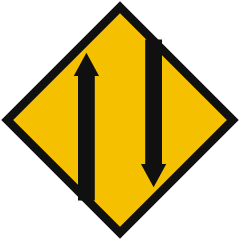
28. Which action becomes clearly more risky beyond this sign?
Show answer
Answer A: Using the left side of the roadway to overtake
With vehicles coming the other way on the same pavement, overtaking on the left needs enough clear road to pull out, pass and return, which is often not available.
-
29. Beyond exchanging information, what other duty does Texas law place on a driver at the scene of an injury collision?
Show answer
Answer B: Providing reasonable assistance, including arranging transportation to medical care if it is needed
Section 550.023 also requires a driver to render reasonable assistance, including arranging transportation for medical care when it is apparent that treatment is necessary.
-
30. When does Texas law require a child to ride in a child passenger safety seat system?
Show answer
Answer D: Until the child is 8 years old, unless the child is already taller than four feet nine inches
A Texas driver commits an offense by carrying a child under 8 who is not taller than four feet nine inches without a child passenger safety seat used as the manufacturer directs, and the fine runs from 25 to 250 dollars.